- Supplementation
- 0 likes
- 41 views
- 0 comments
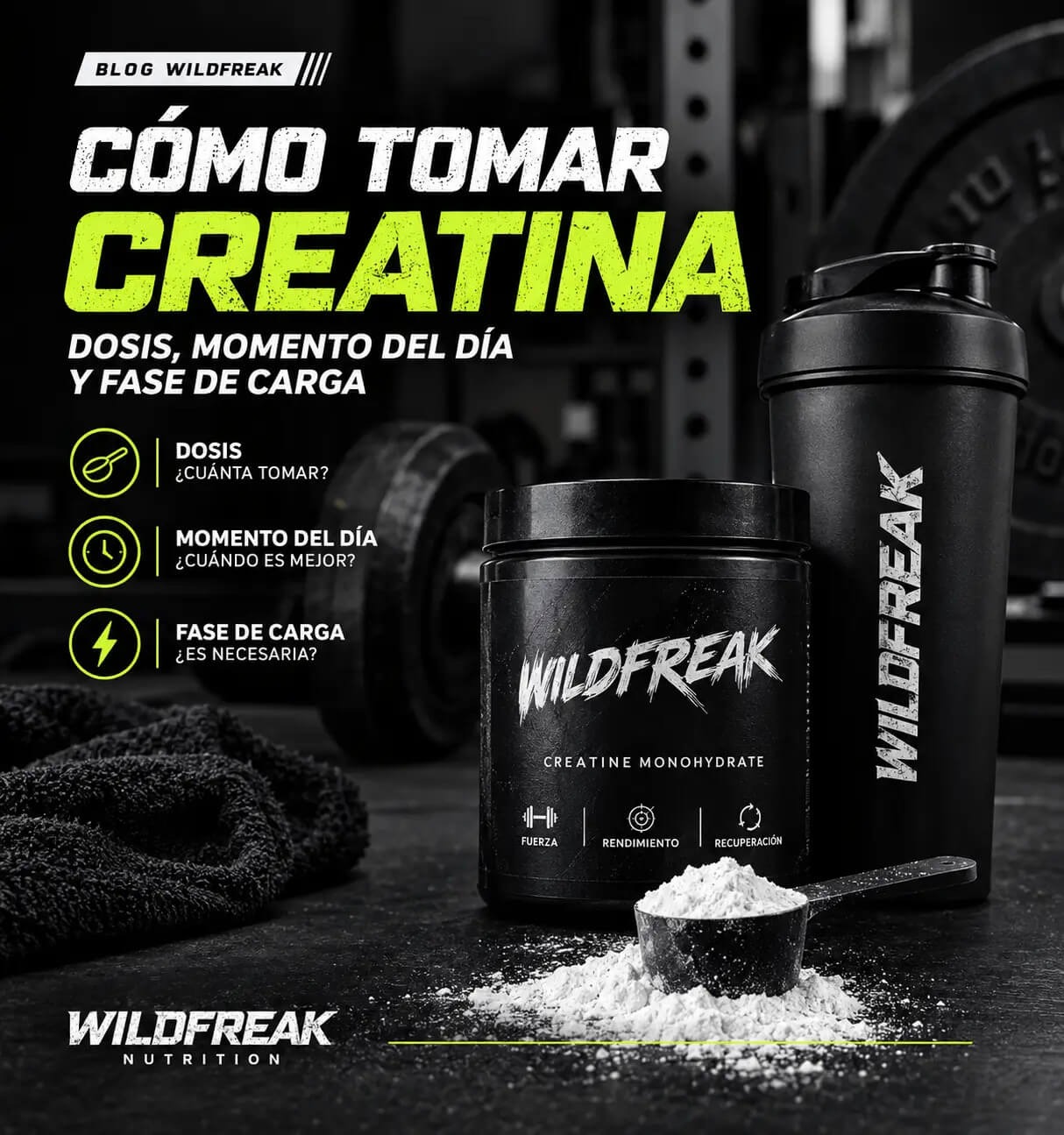
Creatine monohydrate is the most scientifically backed sports supplement in existence. Yet, at the gym, I get asked the same questions every week: how much should I take? When? Do I need a loading phase? Should I take a break from it? Here are the answers—no myths, just practical advice for your daily routine.
What is creatine and what does it do?
Creatine is a compound your body produces naturally; you also get it from meat and fish. It is stored primarily in your muscles as phosphocreatine—an energy reserve used for short, intense bursts of effort, such as a set of squats, a sprint, or a jump.
Supplementing allows you to saturate these stores beyond what you could achieve through diet alone. The result is that you can perform a few extra repetitions per set and recover better between sets. That is why European regulations allow the claim that creatine increases physical performance during successive bursts of short-duration, high-intensity exercise when taken at a daily dose of 3 g.
How much creatine should you take daily?
- Maintenance dose: 3 to 5 g per day. For most people, 3 g is sufficient. If you weigh over 90 kg or have a large amount of muscle mass, 5 g is a good benchmark.
- More isn't better. Taking 10 g daily on an ongoing basis yields no extra benefits; muscles have a storage limit, and any excess is simply eliminated by the body.
A level scoop from a standard measuring tool usually holds around 3 g, but always check your product's label.
Is a loading phase necessary?
It is not mandatory. There are two paths, and both lead to the same result:
- With a loading phase: about 20 g per day, split into four 5 g doses over 5 to 7 days. Afterward, take 3–5 g daily. You saturate your stores within a week.
- Without a loading phase: 3–5 g per day from day one. You reach the same saturation level in about 3–4 weeks.
My recommendation for most people: start directly with 3–5 g daily. It’s more convenient, you avoid the digestive discomfort that sometimes accompanies high doses, and you end up in the same place after a month. Loading only makes sense if you have an upcoming competition or physical test and want to feel the effects as soon as possible.
When should you take creatine?
The important thing is to take it every day, including rest days. The exact time matters much less than you might think.
Some studies suggest a slight advantage to taking it around your workout, especially afterward. A good habit is to mix it into your post-workout protein shake or consume it with a carbohydrate-rich meal; insulin helps drive it into the muscle.
On rest days, take it with breakfast or whichever meal is easiest for you to remember.
Coach's tip: link taking creatine to something you do every day without fail, like your morning coffee. Consistency beats any "perfect moment."
What to mix it with
- Water, juice, or your protein shake. Any of these work.
- Coffee: this is also a compatible option. The idea that caffeine "cancels out" creatine stems from older studies using very high loading doses and has not been confirmed in practice.
- If you find it hard to dissolve, choose micronized creatine (e.g., 200-mesh); it mixes much better and doesn't leave sediment at the bottom.
Do I need to cycle it or take breaks?
No. There is no evidence that you need to stop taking it periodically. Your body does not "get used to it" or permanently stop producing its own creatine. You can take it continuously.
Water retention: the facts
During the first few weeks, it is normal to see the scale go up by 0.5 to 2 kg. It isn't fat; it is water stored inside the muscle along with the creatine. This intracellular water doesn't make you look "bloated" and is simply part of how the supplement works.
If you do experience abdominal bloating, it is usually due to taking high doses all at once (for example, during a loading phase). Try spreading out your intake or reducing it to 3 g per day.
Is it safe?
Creatine monohydrate is one of the most studied supplements in the world; in healthy adults, at recommended dosages, it has an excellent safety profile. If you have kidney disease, take regular medication, or are pregnant, consult your doctor first.
Which creatine to choose
Look for pure creatine monohydrate—avoid blends or "advanced formulas" that drive up the price without offering extra benefits. If you want the highest guarantee of purity, there is Creapure®, which is manufactured in Germany.
Related products

- -10%


- On sale!
- -10%


- -10%
Comments (0)